Tanzania
My trip to Tanzania took me inside homes made of mud, through the breathtaking Ngorongoro Crater, into Olduvai Gorge to see the evolution of humans, and to the great Serengeti National Park to see the wildebeest migration.
GETTING THERE
Many travelers who want to visit the Serengeti fly into Kilimanjaro International Airport JRO, on flights from across Africa and Europe. Visitors also fly into the airport in Arusha ARK, the city is known as the safari capital of Tanzania.
Travelers can also drive to Tanzania from a neighboring country. That's how I did it, arriving overland from Kenya, on a small group safari.
AMAZING EXCURSIONS
As we drove into Tanzania, the weather got much cooler when we went past the mighty Mount Kilimanjaro, standing proud as Africa's tallest mountain. We drove by many traditional homes - circular shaped mud and stick huts. I visited one house just about 10 x 10 feet wide and about 5 feet high. It was amazing how well the family utilized the small area. When I crouched inside, the first section off to the side was for new calves from their herd. Then there was a living area with a fire pit in the middle for food and warmth, and a small hole in the ceiling for smoke to escape. There were two small sleeping areas off the living area, both were covered with animal hides. A family of five lived here, mom and dad in one bed, the three children in the other. They ate a traditional concoction of cow blood mixed with milk. They would knife a hole into the neck of the animal, drain blood to drink, then stop up the hole with a stick, mud, or hot fire ash. This way they didn't need to kill an animal for protein. Their herd acted as an 'investment portfolio'. It determined their wealth so the more animals a family had the better.
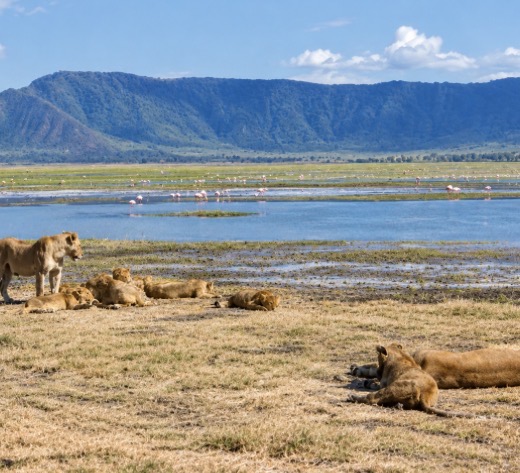
From there, it was on to Ngorongoro Crater, an extinct volcano that's lush and green inside, with a huge lake and thousands of pink Flamingos, their heads arched downward bobbing in the water, their large beaks scooping up algae to eat. The animals inside this UNESCO World Heritage Site didn't migrate, so they stayed in their spectacular surroundings year round. The Big 5 were everywhere, I spotted all in just 4 hours!
It was here that I witnessed a lion hunt, up close. I was inside the large safari van, about twice the length of a Humvee and three times as tall, open air on top with no glass windows. All of a sudden I saw a group of wildebeest running, and one darted into the lake with a large female lion hot on its heels. My guide said it was the wildebeest strategy to get to deeper water because the big cats would rarely follow. Water was shooting up everywhere, but the wildebeest ran onto a sandbar instead of deep water and the lion got it! Once the animal was down, two other female lions and 7 cubs came running out of the bushes! It was incredible as they all ran onto the sandbar, played with the fallen animal for about an hour, leaping over each other, standing on top of their prey, playing with its tail, licking it. Finally, big momma dragged the animal out and they started eating from the soft belly. We didn't see a male lion with this pride, he would have eaten first, but without him eating there was plenty of food and they feasted for hours. After they were full, one of the lions licked clean the lion that did the kill.
In a different section of the crater, I saw two male lions, which were truly the most magnificent looking creatures I'd ever seen. Majestic and proud, and not at all concerned about the presence of humans. They knew they were the kings!
From Ngorongoro Crater we went to Olduvai Gorge and Laetoli, UNESCO World Heritage Sites, which revealed much about the evolution of humans. There were hominid footprints found dating back 3.6 million years. They were in mud, then solidified when the volcano erupted in the ancient past. On a higher layer of sediment, about two million years ago, scientists discovered remains of Homo Habilis, nicknamed Handyman because he made stone tools. On yet another higher layer, scientists found 'Homo Erectus', known for his upright body and walking ability, which allowed him to leave Africa. Finally on another layer, scientists discovered remains of Homo Sapiens, known for their brain and intellectual abilities.
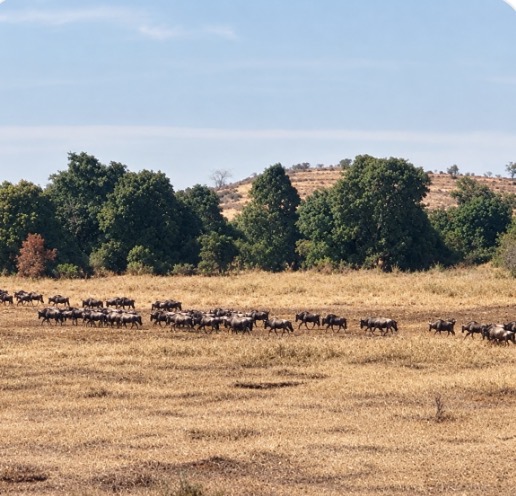
The safari continued on to the Serengeti National Park, another UNESCO World Heritage Site. We drove to the Northwestern Corridor, to see the Wildebeest Migration up close at the Grumeti River. It was breathtaking to see the animals crossing. Back at our campsite, there were plenty of permanent residents - Lions, Giraffe, Elephant, Hippo. There were patches of rock hills dotting the landscape, with brown grass in the fields, where the animals wandered, for all to see. It was nerve racking yet thrilling to be in a simple tent in the middle of the night, with animals snorting and growling all around us, elephants trumpeting.
My trip to Tanzania was a fascinating adventure into the world of wild animals and into the history of humans. My memory of Ngorongoro Crater, Olduvai Gorge, the lion hunt, and the wildebeest migration will be etched in my mind forever.